Your Newtown Assessment Just Changed. Here's What the Number Actually Means
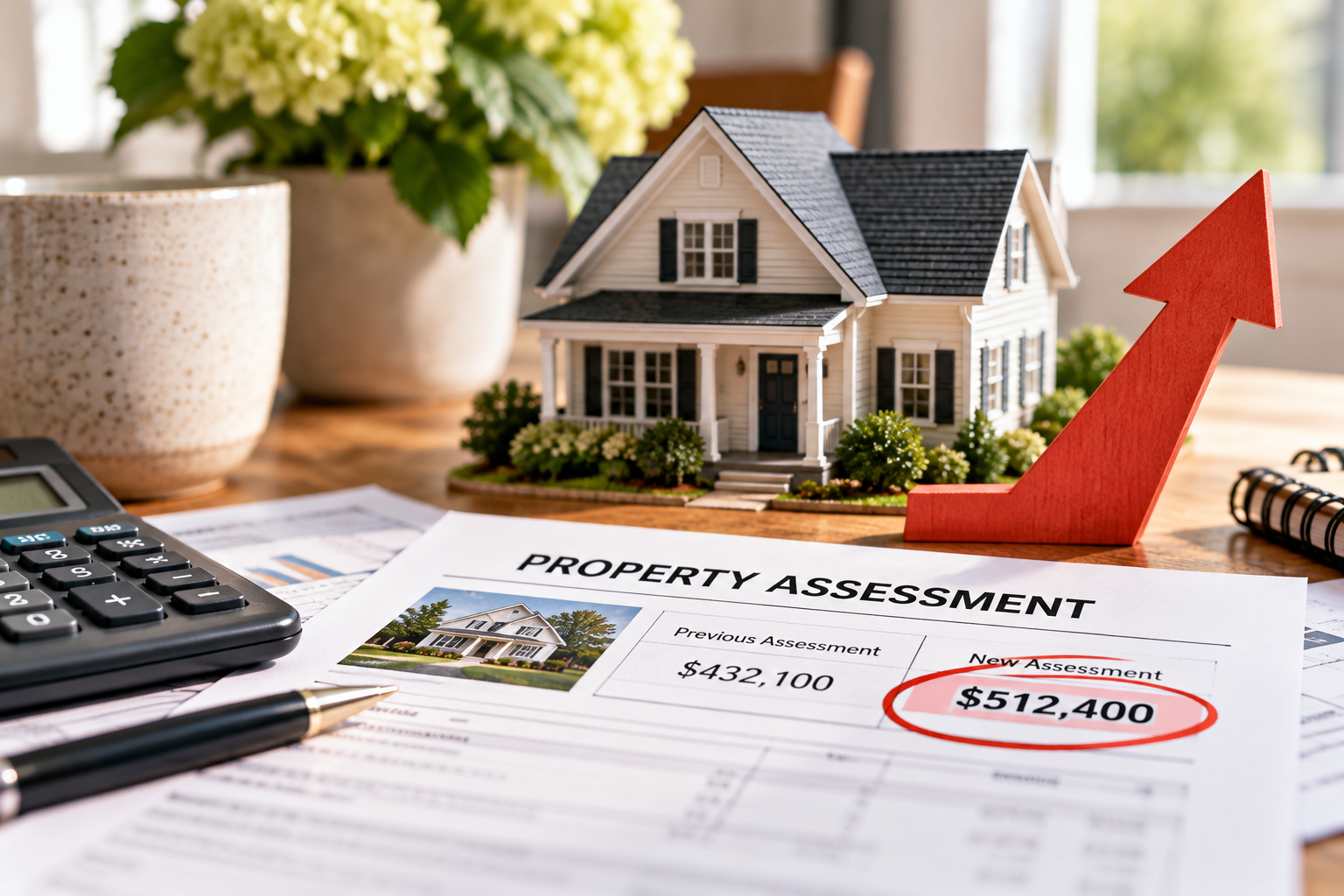
Direct answer: Newtown's 2026 revaluation is live — new values take effect on the October 1, 2026 grand list, notices are hitting mailboxes now, and your tax bill doesn't change automatically (the mill rate gets reset). If you think your number is wrong, talk to the assessor informally first, then file a formal appeal with the Board of Assessment Appeals by February 20, 2027. No, Connecticut is not adding a statewide property tax on top of your local one — but there IS a new $50,000 homestead exemption coming. Here's the straight talk.
That envelope from the Town of Newtown isn't a bill, and it isn't a threat — it's your new assessment, and half the town is reading theirs wrong. So let's do what we always do here: the real numbers, the real deadlines, and zero panic. Because panic is how people end up yelling at the assessor's office in February and getting nowhere.
What even is a revaluation?
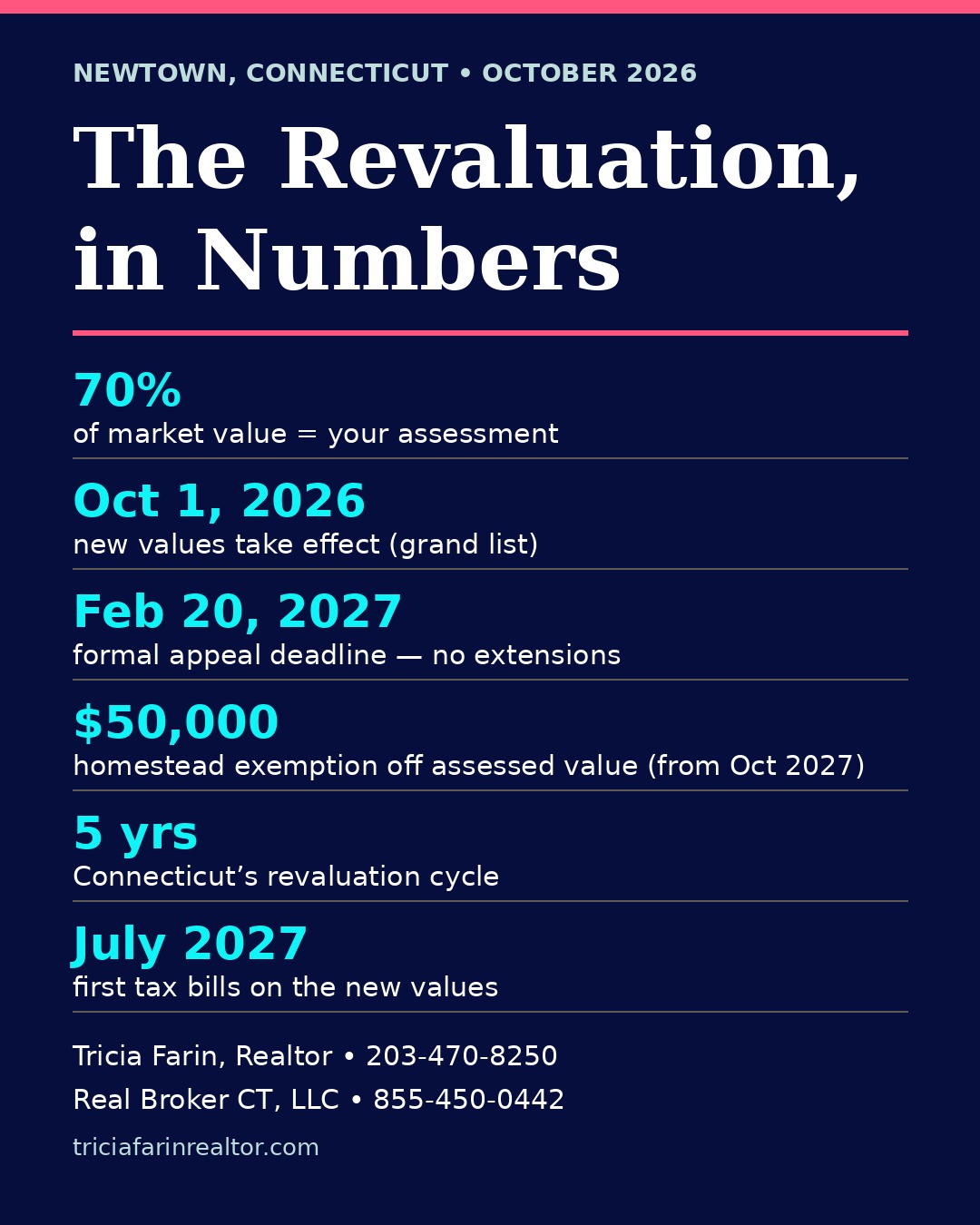
Connecticut law says every town has to revalue all taxable property every five years. Newtown's turn is the October 1, 2026 grand list, and it's not alone — 30-plus Connecticut towns are on this same cycle (Brookfield, Danbury, Monroe, Trumbull, and a bunch more in our corner of the state).
What the town is doing: estimating what your property would have sold for on the open market, then setting your assessment at 70% of that number. That 70% figure isn't a rumor or a rule of thumb — it's state law. Your assessment = 70% of fair market value, and it stays put for the whole five-year cycle unless you appeal, renovate, or demolish something.
Key takeaway: Revaluation doesn't decide how much money the town collects. The town budget does that. Revaluation just decides how the pie gets sliced up between neighbors.
So — is my tax bill going up?
 Maybe. But here's the part most people miss: after a reval, the town sets a NEW mill rate. If every home in Newtown went up 25% and the mill rate stayed the same, the town would collect 25% more money, and the budget process doesn't work that way. The new mill rate gets adjusted so the levy stays roughly in line with what the town actually needs to spend.
The math that matters is how YOUR home changed relative to everyone else's:
| Before reval | After reval (illustrative) | |
|---|---|---|
| Market value of your home | $700,000 | $860,000 |
| Assessed value (70%) | $490,000 | $602,000 |
| Mill rate | 26.35 | ~21.45 (re-set) |
| Annual tax bill | ~$12,912 | ~$12,912 |
Illustrative example only — the actual new mill rate won't be set until before the July 2027 bills go out. Figures move — verify before making decisions.
Your home appreciated ~23%. If the town average appreciated ~23%, your bill barely moves. If yours went up 35% and your street went up 20%, congrats — you get to carry more of the pie. If yours went up less than average, your bill could actually drop even though your home is "worth more."
And timing: the new values show up on tax bills in July 2027. The July 2026 bill you just paid was based on the old numbers.
Key takeaway: Don't compare your new assessment to your old one and call it a tax increase. Compare your home's change to the town average — that's the number that decides your bill.
What if I think my number is wrong?
Then do something about it, in this order:
- Start with the informal route. After the notices go out, the town typically offers informal hearings with the revaluation staff to review your number. This is the easy, no-paperwork window — use it.
- File a formal appeal if that doesn't fix it. Written appeals to Newtown's Board of Assessment Appeals are due by February 20, 2027. That deadline is statutory — it cannot be extended, and missing it is the most expensive mistake on this entire page.
- Last resort: Superior Court. If the board's decision doesn't satisfy you, you can appeal to Superior Court within two months of the board's decision mailing.
To know whether your number is actually wrong (versus just annoying), do two things: pull recent comparable sales in Newtown near your home's condition and features, and check whether similar homes in your neighborhood were assessed at similar values. Connecticut requires assessments to be equalized — if comparable houses got lower assessments, that's a real, actionable argument even if your own number seems defensible on its own.
Key takeaway: The assessor's office is not your enemy, but February 20, 2027 is a brick wall. Start now and you have months of runway; start in February and you're sprinting.
Is Connecticut really adding a statewide property tax on top of my local one?
No. Let's kill this rumor dead, because I've heard it from three different clients this month.
What actually happened: in the 2026 legislative session, Senate President Martin Looney backed a bill that would have imposed a statewide tax — but ONLY on residential property assessed over $3 million (2 mills on $3–5M, 3 mills on $5–10M, 4 mills above $10M). A mansion tax, not a tax on regular homeowners. It got a public hearing in February and went no further. The session wrapped up in May 2026 with no such law.
Nobody — not the governor, not the legislature — is proposing that ordinary homeowners pay both a city and a state property tax. The real fuel for the rumor is reval-driven sticker shock: people see a bigger assessment number and assume a bigger bill is a new tax. It's not. It's the same old local property tax, redistributed.
Key takeaway: If your home isn't worth $3M+, the "state property tax" is a rumor, full stop. Watch your local assessment and mill rate — that's where your actual bill gets decided.
What's this $50,000 homestead exemption I keep hearing about?
This one is real, and it's good news — with a catch on the calendar.
The legislature passed a statewide homestead exemption (Senate Bill No. 1): starting with assessment years on or after October 1, 2027, towns must knock $50,000 off the assessed value of an owner-occupied primary residence. At Newtown's mill rate, that's real money off your bill every year.
The catch: it starts with the October 2027 grand list, so it won't touch your July 2027 bill — first relief lands on the July 2028 bill. And you'll need to file an annual declaration form with the assessor (deadline: November 1 each year) confirming it's your primary residence. Miss the form, miss the exemption.
Key takeaway: Relief is coming, but not this cycle. Mark November 1, 2027 for the paperwork, and in the meantime, this reval still deserves your full attention.
Don't live in Newtown? Read this part anyway.
Revals hit every Connecticut town on its own five-year cycle, so if your town isn't on the 2026 list, your turn is coming — or just passed. The playbook is identical everywhere:
- Find your town's schedule: your town assessor's webpage, or the statewide mill-rate and revaluation schedule (SmartMLS publishes one agents use all the time). Your next reval date is printed there.
- Same 70% rule statewide. Your assessment should be 70% of market value whether you're in Newtown or New London.
- Same appeal ladder everywhere: informal hearing, then your town's Board of Assessment Appeals (the February 20 deadline applies to reval-year towns), then Superior Court.
- Same homestead exemption coming — it's statewide, effective October 2027, for owner-occupied primary residences in every town.
Where to find your town's assessment data right now: most Connecticut towns have their property records searchable online (Newtown's are on the town website through the assessor's page). Start there before you decide anything is wrong.
Key takeaway: The town name changes; the mechanics don't. Notices, informal review, February 20 appeal deadline, new bills the following July, $50K exemption from October 2027.
Smart Moves Start Here
One more thing, because somebody always asks: I'm a real estate agent, not a tax attorney or an assessor. If you want to fight your assessment, talk to the Town of Newtown Assessor's Office (or your town's assessor) — they can tell you exactly what they saw in your property.
But if this reval has you rethinking your house — "maybe I sell before the tax bill lands" or "maybe now's the time to buy before everyone else figures out the math" — that's my lane. Thinking about buying or selling in Newtown, Fairfield County, or anywhere in Connecticut? Let's talk strategy. And if financing questions come up, I'll connect you with a trusted local mortgage lender who'll run your real numbers. No pressure, no sales pitch. Just straight talk.
Categories
Recent Posts