The Connecticut Town You Can Afford May Not Be the Town You Think

You found the perfect Connecticut town.
You've been watching the listings.
You know the neighborhoods.
You've saved the houses.
And you've also discovered one tiny problem:
You can't afford the house you want there.
So what do most buyers do?
They start compromising.
Smaller house.
Smaller yard.
More work.
Less desirable location.
Or they keep waiting for that magical listing that checks every box and somehow fits the budget.
Good luck with that.
Here's a better strategy:
Stop shopping for a house and start shopping for the right market.
The Connecticut town you can actually afford may not be the town you originally had in mind.
And that doesn't necessarily mean you're settling.
It may mean you're shopping smarter.
Your Budget Doesn't Change. Your Options Should.
Let's say you've decided you want to spend $600,000.
You start looking in one particular town and discover that $600,000 gets you a smaller, dated house that needs work.
Your first instinct might be:
"I guess I need to spend more."
Not necessarily.
Before increasing your budget, ask:
What would that same $600,000 buy me five or ten miles away?
You might find:
-
A larger house
-
A better lot
-
A move-in-ready property
-
A newer home
-
A quieter neighborhood
-
Lower property taxes
-
More amenities
-
Or simply fewer compromises
That's not giving up.
That's expanding the playing field.
The "Right Town" Is Personal
One of the biggest mistakes buyers make is assuming there's a universally "best" Connecticut town.
There isn't.
There's only the town that's best for you.
For one buyer, that means a short commute.
For another, it means excellent restaurants and a walkable downtown.
Someone else wants privacy, acreage and a garage big enough to hold every hobby they've accumulated over the last 20 years.
A first-time buyer might prioritize affordability.
A growing family might prioritize schools and space.
A downsizing buyer might care more about maintenance and proximity to healthcare, shopping and restaurants.
And an investor has an entirely different set of criteria.
So before you decide you have to live in one particular town, figure out what you're actually trying to buy.
Don't Confuse a Town's Reputation With Its Value
Some Connecticut towns have a strong reputation.
That's not necessarily a bad thing.
But reputation can come with a price.
Buyers sometimes pay a premium to be in a particular town without fully understanding what they're getting in return for that premium.
If two communities offer similar:
-
Commute times
-
Housing stock
-
Amenities
-
Lot sizes
-
Access to highways
-
Shopping and restaurants
but one costs substantially more, it's worth asking:
What exactly am I paying extra for?
Sometimes the answer is obvious.
Sometimes it isn't.
And sometimes the answer is simply that the market has decided one town is more desirable.
That doesn't mean you have to agree with the market.
Look at the Town Next Door
This may be the simplest strategy—and one of the most overlooked.
If you love a particular town but can't find what you want within your budget, don't immediately move your price range.
Look at the surrounding communities.
The town next door may offer a completely different value proposition while keeping you close to everything you actually like about the original location.
You may still be:
-
10 minutes from the restaurants you love
-
Close to the same major highways
-
Near the same shopping
-
Within a similar commuting distance
-
Close to family and friends
-
Near the activities you care about
But your housing budget could stretch considerably further.
That is a conversation worth having before you decide you need another $100,000 in purchasing power.
Here's Where Buyers Get Tripped Up: Taxes
Now let's make this more interesting.
A lower purchase price does not automatically mean lower housing costs.
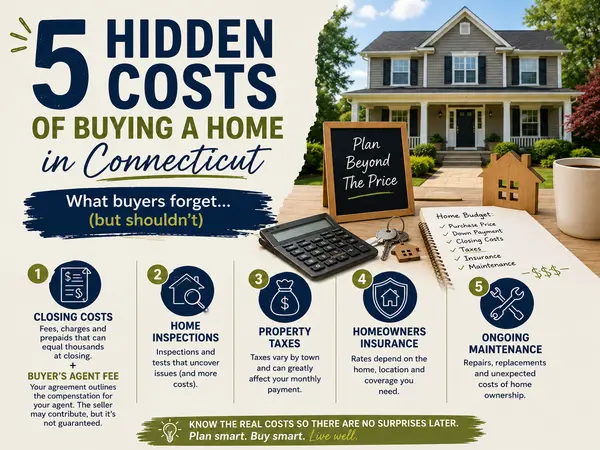
Connecticut property taxes vary by municipality, so you need to look at the actual tax bill—not simply the purchase price.
For example, imagine two homes:
House A: $575,000 with higher property taxes
House B: $625,000 with lower property taxes
Which one is actually more affordable?
You can't answer that based on the listing price.
You need to look at the total monthly cost.
That's why I tell buyers:
Don't shop by purchase price alone. Shop by total cost of ownership.
The "Bigger House" Trap
There's another problem with expanding your search.
You find a town where your $600,000 budget suddenly buys a 3,500-square-foot house instead of a 2,400-square-foot house.
Fantastic.
Until you realize that you're now responsible for:
-
More heating and cooling
-
More roof
-
More siding
-
More flooring
-
More windows
-
More landscaping
-
More maintenance
-
More furniture
And if the house is older?
Potentially more repairs.
More house isn't automatically more value.
Sometimes the smaller, better-maintained house is the smarter purchase.
Don't Forget the Commute
This is especially important if you're considering expanding your search geographically.
Saving $75,000 on a house isn't necessarily a bargain if you add an hour to your daily commute.
Do the math.
If you commute five days a week, an extra hour each way adds up quickly.
And that's before you factor in:
-
Gas
-
Tolls
-
Vehicle wear
-
Parking
-
Your time
A less expensive house farther away can become considerably less attractive when you're sitting in traffic wondering why you did this to yourself.
Your commute is part of the price of the house.
Treat it that way.
Think in Terms of "Trade-Offs," Not "Compromises"
This is a mindset shift that can make house hunting much easier.
Instead of saying:
"I can't afford the town I want."
Try asking:
"What am I willing to trade to get what matters most?"
Maybe you give up:
-
A half-acre lot for a quarter-acre
-
A newer kitchen for a better location
-
A garage for a larger living space
-
A specific school district for a lower price
-
A 2,800-square-foot house for a 2,300-square-foot house
Those aren't necessarily bad compromises.
They're trade-offs.
Every real estate purchase involves them.
The trick is deciding which ones matter and which ones don't.
The House You Don't Buy Can Be Just as Important
Sometimes buyers become so focused on finding the house that they forget to evaluate the market they're buying into.
Ask yourself:
-
How long do homes typically stay on the market?
-
What does inventory look like?
-
Are buyers competing aggressively?
-
How much are homes actually selling for?
-
Are there meaningful differences between asking prices and sale prices?
-
What types of homes are available at my price point?
-
How difficult will this property be to resell?
You're not just buying a house.
You're buying into a location.
And location doesn't stop mattering after closing.
Here's a Better Way to Search
Instead of telling your Realtor:
"I want to live in Town X."
Try this:
"Here's what I want my life to look like, and here's my budget."
Then identify the communities that could realistically give you that lifestyle.
For example:
"I want a three-bedroom home, a decent yard, a reasonable commute, restaurants within 15 minutes, and I want to stay around $600,000."
That's a much better starting point than:
"I only want to live in this one town."
Because the first approach gives you options.
The second one may give you frustration.
What If You Really Want That One Town?
That's okay.
Sometimes a particular town genuinely matters to you.
Maybe your family is there.
Maybe your children are already established there.
Maybe your commute makes another location impractical.
Maybe you simply love it.
Then own that decision.
But understand the trade-off.
If the budget is $600,000 and the homes you want are $700,000, something has to give.
You can:
Increase the budget.
Lower your expectations.
Wait.
Or expand the search.
There isn't a secret fifth option where the perfect house suddenly becomes $100,000 cheaper because you really, really want it.
The Bottom Line
The goal isn't to find the cheapest town in Connecticut.
It's to find the town that gives you the best combination of lifestyle, location, housing and affordability.
Sometimes that will be the town you originally wanted.
Sometimes it will be the town next door.
And sometimes you'll discover that the place you never considered is actually a much better fit for the life you're trying to build.
That's why smart home buying isn't simply about searching harder.
It's about searching smarter.
Before you increase your budget or start eliminating everything you love about a house, take a step back and look at the bigger map.
Your dream home may not be in your dream town.
And that's not necessarily a bad thing.
Smart Moves Start Here.
Categories
Recent Posts