
How to Prepare Your Connecticut Home for a Winter Sale
How to Prepare Your Connecticut Home for a Winter Sale
Direct answer: Listing your Connecticut home in winter is absolutely viable — far less competition, and only the year's most serious buyers show up. But you have to price it precisely, keep the house warm and bright, and winterize before the first freeze. Homes sell slower and fetch slightly less of asking than in spring, so flawless prep is the whole game.
Everyone and their cousin's agent will tell you spring is the only season to sell. And sure — May is the prom queen of listing months. But here's what the prom-queen narrative leaves out: the buyers touring in January aren't killing time. They're relocating for jobs, closing out divorces, upsizing before a baby, or grabbing a house before their lease ends. Nobody trudges through a Newtown colonial in 28-degree weather for fun. Winter buyers are the most qualified, most motivated buyers of the year — and if your house is the warm, glowing, move-in-ready one on the market, you own that room.
Fair warning, though: winter rewards preparation and punishes laziness. The houses that sit until April in Connecticut aren't victims of the season — they're victims of bad pricing, a 62-degree thermostat, and photos taken on a gray afternoon. Do the work, and winter can be your secret weapon.
Should I even bother listing in winter?
Yes — with your eyes open. Here's the honest seasonal math (national 2025 data, Redfin):
| December–January listings | May–July listings | |
|---|---|---|
| Median share of asking price received. | ~98.0–98.2% | ~99.0–99.4% |
| Median days on market | 59–70+ | 40–43 |
| Competing new listings | Roughly half of spring's volume | Peak inventory |
Translation: you give up about a point of asking price and add roughly three weeks on market — and in exchange, you're competing against a fraction of spring's listings, with buyers who are actually buying. Last winter told the same story: December closings held their prices while new listings ran about half of spring levels.
Key takeaway: Winter isn't a discount season — it's a low-competition season. The gap is real but small, and the buyers are better.
What's the #1 thing that kills a winter sale?
A cold house. Full stop.
A buyer walks in from 30-degree air and your thermostat says 62, and their brain files your house under "uncomfortable, drafty, expensive to heat." They don't think about it consciously. They just don't make an offer.
68–70°F during every showing. That's the number. For a vacant listing, never drop below 55°F — frozen pipes burst, insurers get cranky, and a $15,000 water-damage claim will torpedo your sale faster than anything else in this article.
And here's the Connecticut-specific elephant in the room: heat is expensive right now. Like, sticker-shock expensive. This week's EIA numbers:
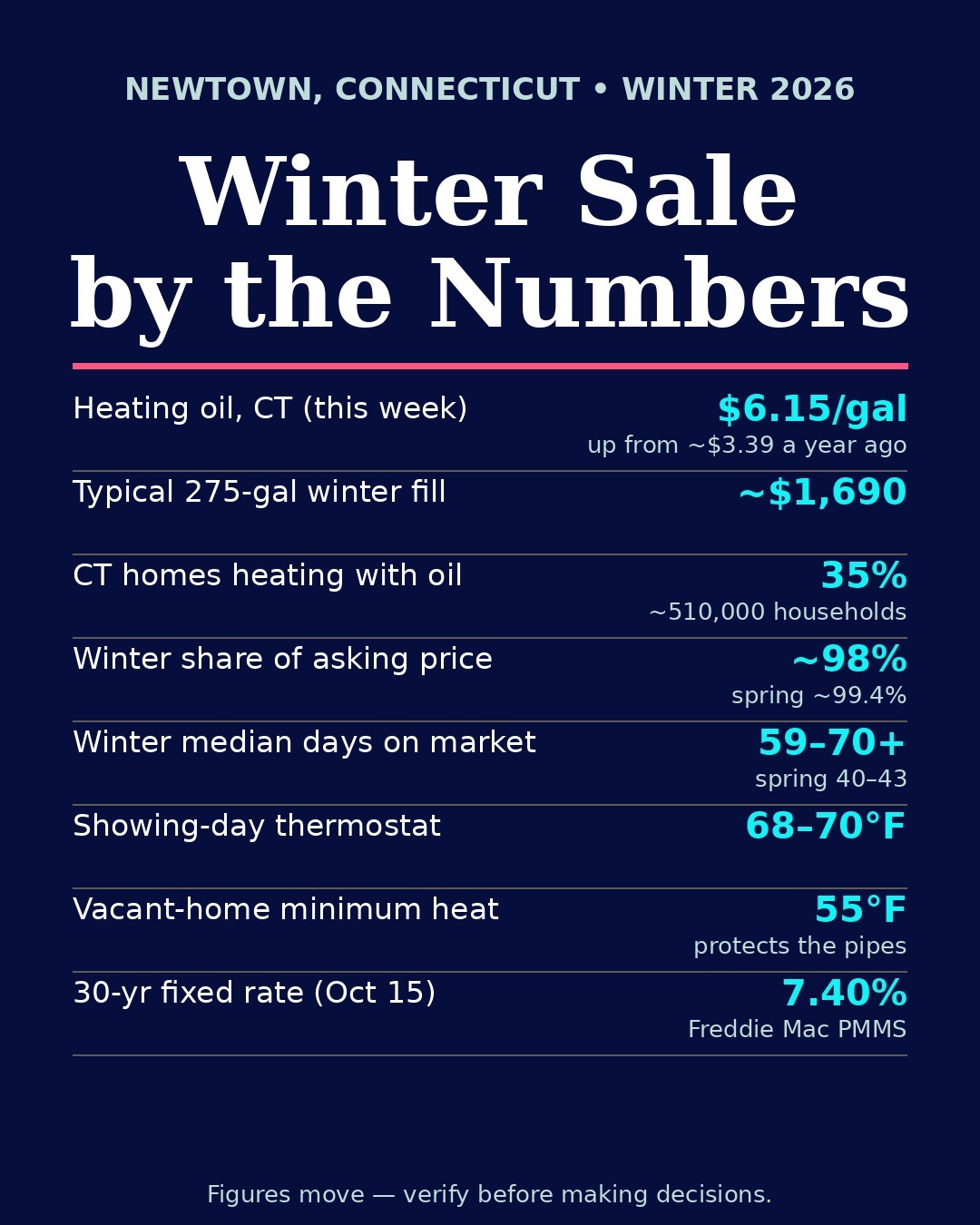
| Connecticut, week of Oct 19, 2026 | One year ago | |
|---|---|---|
| Heating oil (per gallon) | $6.15 | ~$3.39 |
| Typical 275-gallon fill | ~$1,690 | ~$930 |
Source: EIA Heating Oil & Propane Update. Figures move — verify before making decisions.
Thirty-five percent of Connecticut homes heat with oil — roughly 510,000 households — so if yours is one of them, your buyers are going to ask about fuel bills, and they're going to ask early. Beat them to it: pull 12 months of heating and electric bills and put them in the showing packet. Nothing defuses a scary number like receipts. If your system is new, say so loudly. If you've got a heat pump, mini-splits, or a recent boiler, that is marketing gold this winter.
Key takeaway: A warm house sells. A cold house gets a "we'll think about it" that never comes back. And this winter, your fuel bills are part of your sales pitch — document them before buyers ask.
What do I actually need to fix before the first freeze?
Not a renovation. Winterization — the stuff that protects your house and photographs well. Do these before Thanksgiving and you're ahead of 90% of winter sellers:
| Fix | Why it matters | Rough cost |
|---|---|---|
| Furnace/boiler serviced | A dead furnace on showing day is a disaster; buyers' inspectors flag unserviced systems anyway | $150–$250 |
| Chimney swept and inspected | Connecticut buyers love fireplaces — a clean flue is a selling point | $200–$300 |
| Gutters cleaned | Clogged gutters + freeze = ice dams = water in your walls | $150–$300 |
| Weatherstripping + door sweeps | Kills the drafts buyers feel in their bones | $50–$150 DIY |
| Exposed pipes insulated | Basements and crawl spaces freeze first | $50–$100 DIY |
| Outdoor faucets shut off and drained | The #1 winter plumbing emergency | Free |
| Attic insulation checked | Thin attic insulation is what causes ice dams on colonials | Free to check |
| Snow-removal plan in writing | Buyers see the driveway first — and so do their attorneys | See below |
The ice-dam point deserves emphasis, because half of Newtown is colonials with attics. Ice dams happen when heat escapes through an under-insulated attic, melts roof snow, and the water refreezes at the eaves and backs up under your shingles. Prevention is attic insulation and ventilation, not a roof rake — though buy a roof rake anyway.
Key takeaway: This list costs less than a nice dinner out, and every item is something a buyer's inspector would flag in February.
How do I make a gray February day photograph like it matters?
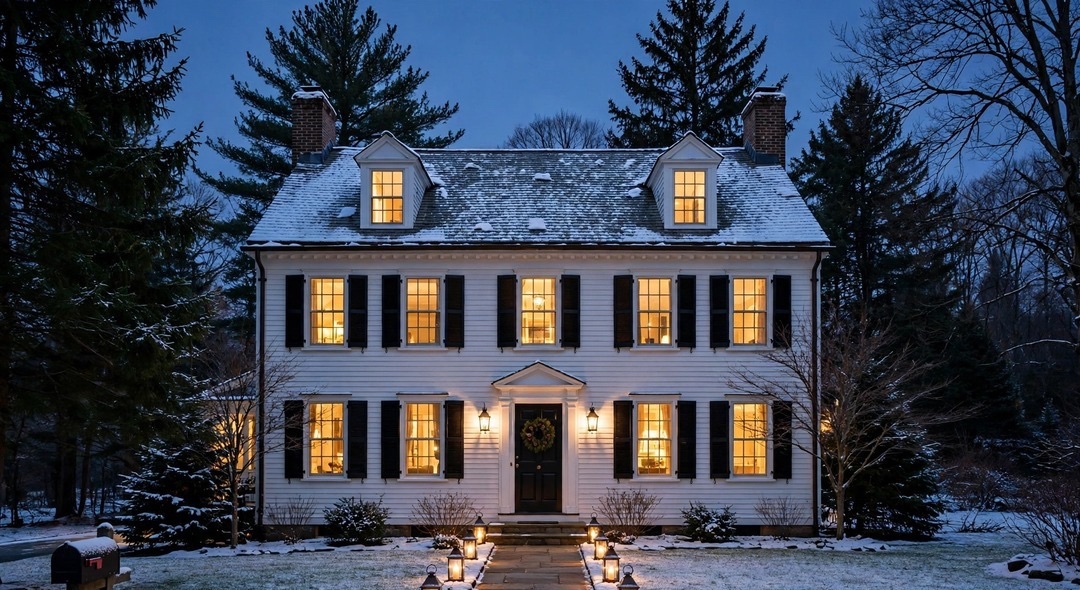
Winter listings have one unfair advantage: twilight photography. A colonial with every light on and snow on the ground at dusk is the single most emotional real-estate image there is. Your spring competitors can't touch it.
The rules:
- Hire the photographer for a twilight session. Daytime winter exteriors are gray, flat, and sad. Dusk shots with warm windows are the money.
- Shoot the exteriors BEFORE the snow melts into slush. Fresh snow is gorgeous. Week-old slush is not. If a storm is coming, call your agent and your photographer that day.
- Every light in the house ON for photos and showings. Replace every dim or dead bulb. Warm-white (2700–3000K), not daylight-blue — you're selling cozy, not a dental office.
- Pull back the heavy curtains. Winter light is scarce; let all of it in.
- Walkways shoveled and salted before every showing. This is curb appeal in winter. Period.
- Rake the leaves before they mat. Wet leaves kill your lawn and look neglected in photos. Late October is your deadline.
- Stage with texture: chunky throw blankets, a lit fireplace if you have one, cider simmering on showing days.
Key takeaway: Winter photos should sell warmth, not square footage. Twilight, lights on, fresh snow — that's the entire formula.
What will a Connecticut buyer ask that a spring buyer won't?
Winter buyers in Connecticut come armed with a very specific set of questions, and "I don't know" on any of them costs you leverage:
- What's the heat source, and how old is the system? Oil, propane, natural gas, heat pump — know the fuel, the system's age, and the service history. If the oil tank is in-ground, know its age. Buyers' attorneys always ask.
- What do you spend on heat? Include 12 months of bills in your showing packet.
- How old is the roof — and any ice-dam history? If you've had ice dams, say what you did about them. Fixed is a selling point; hidden is a lawsuit.
- Any frozen-pipe history? Same rule: fixed and disclosed beats discovered.
- Chimney condition? That sweep receipt from October is your answer.
- Septic or well quirks in winter? Plenty of Newtown-area homes run on septic and wells — completely normal here — and winter buyers will ask whether anything changes when the ground freezes. ("We've had no issues through X winters" is the sentence that ends the conversation.)
- Who plows? Buyers notice driveways. Have the contract or the neighbor's name ready.
Key takeaway: Winter buyers aren't pickier — they're colder. Every answer should make your house feel warmer and more predictable than the next one.
What if it snows on showing day?
This will happen. Have the plan BEFORE the forecast:
- Plow contract or a neighbor on standby — in writing, not a handshake
- Walkway, steps, and driveway cleared and salted before every showing, no exceptions
- A big mat inside the front door plus a boot tray — wet floors are a crime
- Keep your showing agent looped in: if a storm is genuinely bad, rescheduling beats a bad first impression
Key takeaway: The showing plan IS a snow plan. If the walkway's buried, the showing's already over.
Let's talk pricing — what's the honest winter math?
Here it is: the seasonal data says winter listings get roughly a percentage point less of asking than spring listings and sit about three weeks longer. So the winter pricing rule is simple — price it right on day one and don't "test the market."
"Testing the market" in May means a price cut after three weeks and a fresh wave of buyers. "Testing the market" in January means your listing goes stale in a thin market — and stale in winter is fatal. There aren't enough new buyers arriving each week to forgive a bad first impression.
The move: price at or just under the comps, make the first 21 days count, and take a strong early offer seriously. In a thin market, the bird in the hand is worth two in the spring bush.
Key takeaway: Winter forgives nothing on price. Sharp from day one, or sit until the crocuses come up.
Smart Moves Start Here
Thinking about selling this winter in Newtown, Fairfield County, or anywhere in Connecticut? Let's talk strategy — pricing, prep timeline, and exactly what buyers will ask about your heat. And if you're buying your next home too, I'll connect you with a trusted local mortgage lender to run your real numbers. No pressure, no sales pitch. Just straight talk.
Sources: EIA Heating Oil & Propane Update, week of Oct 19, 2026; Redfin seasonal selling data (2025); Freddie Mac Primary Mortgage Market Survey, week ending Oct 15, 2026 (30-yr fixed 7.40%). Figures move — verify before making decisions.
Categories
Recent Posts