
Locked In at 3%? How to Sell and Move in Connecticut at 7% Rates
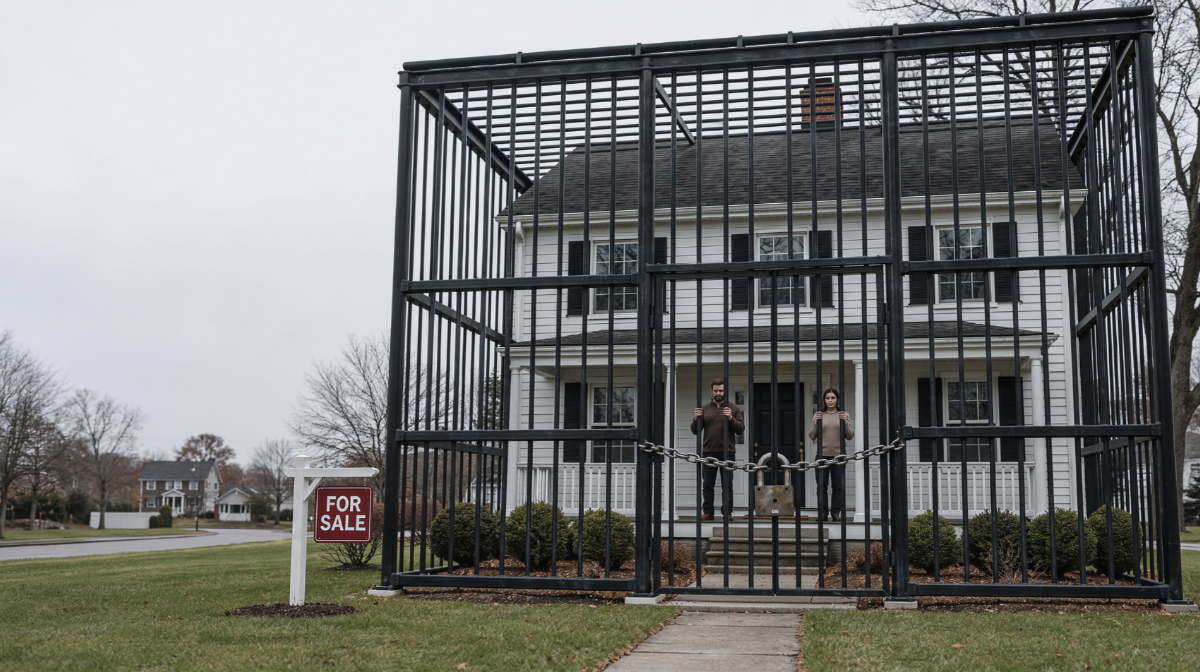
The short answer: if your mortgage rate is 3% and today's rate is about 7.11%, you are not stuck forever. For many Connecticut homeowners, the real cost of moving is far smaller than the scary number in your head, especially if you have built equity. Run your own numbers before you decide to stay put, because the answer might surprise you.
You know the feeling. Your house doesn't fit your life anymore. Maybe you need more room, maybe less, maybe a different town or a shorter commute. But every time you think about selling, you look at your mortgage statement and think: I would be giving up a 3% rate to take on 7%. No way.
That feeling has a name: the mortgage rate lock-in effect. It is real, it is costing the market its sellers, and it keeps millions of homeowners in houses that no longer work for them.
Here is what I tell my clients: lock-in is a math problem, not a life sentence. Some people should absolutely stay put. Others are staying for no good reason. This article shows you how to tell the difference, with real Connecticut numbers.
The Cage Is Real: What the Numbers Say
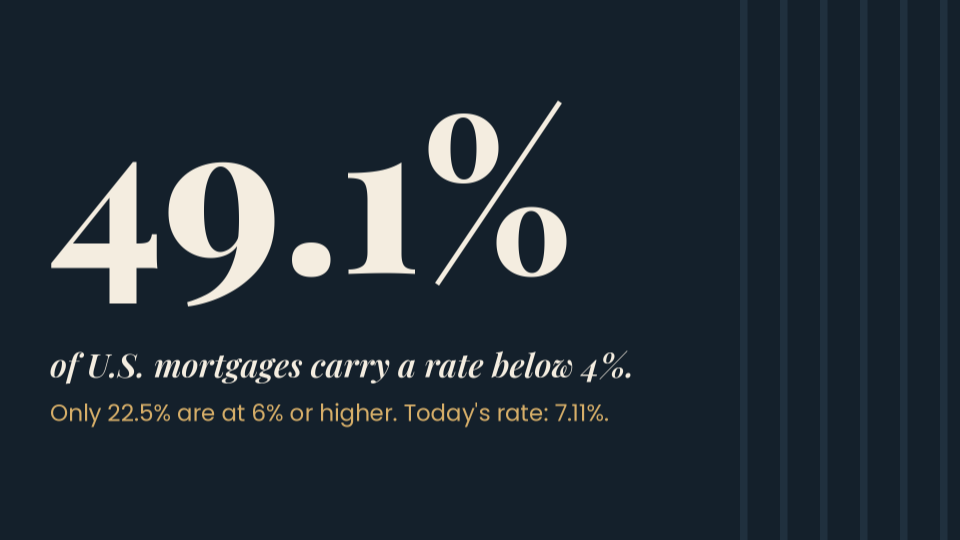
About half of all U.S. homeowners with a mortgage are sitting on a rate below 4%. According to a Realtor.com analysis of the Federal Housing Finance Agency's National Mortgage Database, 49.1% of outstanding mortgages carried a rate below 4% in the second quarter of 2026, and 65.6% were below 5%. Only 22.5% were at 6% or higher (Realtor.com analysis via WRE News).
Now compare that to what a new buyer faces. Freddie Mac's weekly survey put the 30-year fixed rate at 7.11% on November 12, 2026, versus 6.24% a year earlier (Freddie Mac).
The result is a market where people can't move and don't. The National Association of Realtors reported 3.75 million existing-home sales (annualized) in October 2026, the slowest pace since 2010 and down 8.8% from a year ago. The national median price was $416,700, and inventory was 1.59 million homes, about 5.1 months of supply (Fortune, citing NAR).
And don't count on a bailout. The Mortgage Bankers Association's chief economist told The Mortgage Reports he expects the 30-year rate to stay above 7% through 2027 (The Mortgage Reports). Nobody can promise you where rates will go, but "I'll wait for 3% again" is not a plan.
The homeowner who feels trapped is not being dramatic. The question is whether the bars are as thick as they look.
The Real Math: What Moving Actually Costs You
Here is the number nobody runs: your equity. A lateral move at today's rates costs this homeowner about $978 more per month, not the $2,000-plus most people assume. A move up is the true cage. A downsize can actually lower the payment.
The example: you bought five years ago with a $400,000 loan at 3.00% for 30 years. Your principal-and-interest payment is $1,686 and your balance today is about $355,600. You sell at $673,000, a round number close to Newtown's October 2026 median sold price of $687,400 (RealtyTrac). After an assumed 6% in selling costs and paying off the loan, you walk away with about $277,000. You buy your next home at 7.11%.
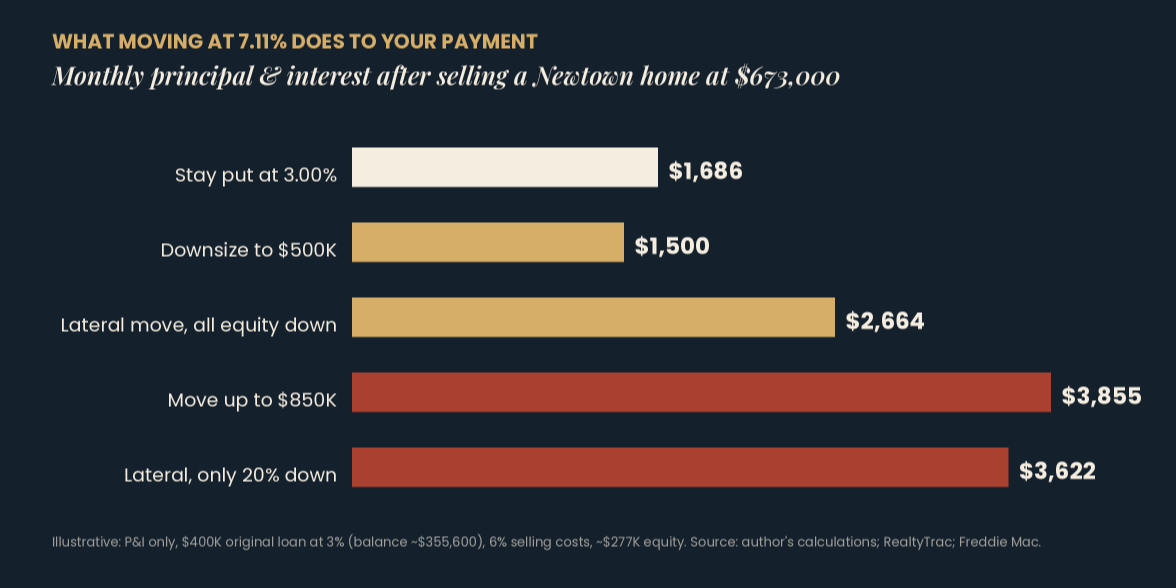
| Scenario | Next home price | Down payment | New loan | Monthly P&I | vs. staying |
|---|---|---|---|---|---|
| Stay put at 3.00% | n/a | n/a | $400,000 original | $1,686 | n/a |
| Lateral move | $673,000 | $277,000 | $396,000 | $2,664 | +$978 |
| Move up | $850,000 | $277,000 | $573,000 | $3,855 | +$2,168 |
| Downsize | $500,000 | $277,000 | $223,000 | $1,500 | -$186 |
| Lateral move, only 20% down | $673,000 | $134,600 | $538,400 | $3,622 | +$1,935 |
Three things jump out:
- Your equity is your escape hatch. Putting your full equity down, not just 20%, cuts that lateral payment by almost $1,000 a month.
- The move up is where the cage is real. An extra $2,168 a month is a budget decision, not a mindset problem. There are ways to shrink that gap (see below), but don't pretend it isn't there.
- Downsizers have the least to fear. If you are moving to something smaller, the math can flip in your favor.
And rates are not a life sentence on the other side of the closing table. If rates fall, you can refinance. On that same lateral loan of about $396,000, a payment at 6.5% would be roughly $2,503, at 6% about $2,374, and at 5.5% about $2,248. Nothing is guaranteed, and refinancing has costs, but you cannot un-sell your house.
These figures are illustrative: principal and interest only, a fixed 7.11% rate (the Freddie Mac weekly average for November 12, 2026), no taxes, insurance or closing costs, and an assumed 6% for selling costs. Your lender's quote and your own numbers will differ.
What's Happening in Your Connecticut Town
The lock-in effect is national, but your sale happens on your street. Here is where six Fairfield County towns stood in the most recent data I could pull. Homes sold are down from a year ago in five of the six, and homes for sale are up in all six, more than doubling in Brookfield, Monroe and Ridgefield. Translation: buyers have more options and more leverage than they did a year ago, and sellers who price like it's 2022 are sitting.
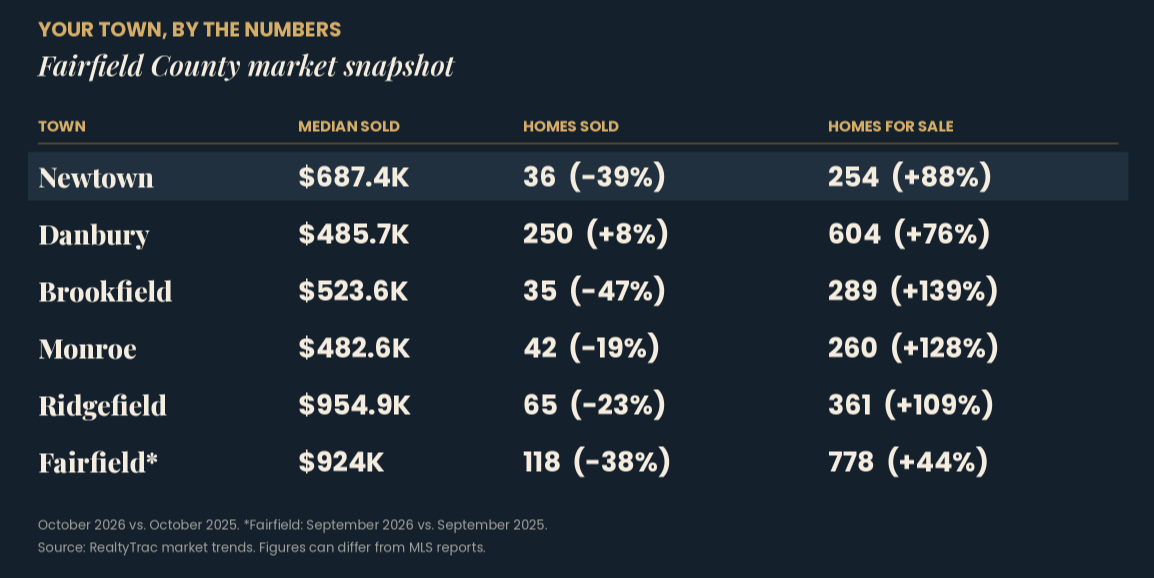
| Town | Data month | Median sold price | Homes sold (vs. last year) | Homes for sale (vs. last year) |
|---|---|---|---|---|
| Newtown | Oct 2026 | $687.4K | 36 (-39.0%) | 254 (+88.2%) |
| Danbury | Oct 2026 | $485.7K | 250 (+7.8%) | 604 (+76.1%) |
| Brookfield | Oct 2026 | $523.6K | 35 (-47.0%) | 289 (+138.8%) |
| Monroe | Oct 2026 | $482.6K | 42 (-19.2%) | 260 (+128.1%) |
| Ridgefield | Oct 2026 | $954.9K | 65 (-22.6%) | 361 (+108.7%) |
| Fairfield | Sep 2026 | $924K | 118 (-37.9%) | 778 (+43.5%) |
Source: RealtyTrac market trend pages for Newtown, Danbury, Brookfield, Monroe, Ridgefield and Fairfield. Figures follow RealtyTrac's definitions and can differ from MLS reports.
A few things worth saying out loud:
- Brookfield sold 35 homes in October, down 47% from last year, while homes for sale jumped 139%. More choices and fewer buyers is exactly how pricing mistakes get exposed.
- Newtown has 254 homes for sale, up 88%, while sales fell 39%. That is not a crisis, but it is not the "sold over the weekend" market of two years ago either.
- Danbury is the exception on volume. Sales rose 7.8% from last year, proof that well-priced homes still move even with inventory up 76%.
- Ridgefield and Fairfield sit at the high end, where inventory is building too: up 109% in Ridgefield and 44% in Fairfield.
Small towns have small samples, so one month can swing a median. Use these as direction, not gospel, and ask me for the numbers on your street before you decide anything.
Five Ways to Pick the Lock
You have more options than "stay forever" or "take the hit." Here is how I help Connecticut homeowners work around a high rate.
1. Put all of your equity to work. In the example above, a 20% down payment on a $673,000 home means a $3,622 payment. Putting the full $277,000 down means $2,664. Same house, same rate, nearly $1,000 a month apart. Equity you keep in a savings account earns far less than the interest you avoid paying.
2. Make the seller pay down your rate. Buyers have leverage in a market where homes sit, and a seller-paid temporary buydown is one way to use it. On the $396,000 lateral loan above, a 2-1 buydown (rate 2 points lower in year one, 1 point lower in year two) would cut the payment to about $2,153 in year one and $2,402 in year two before settling at $2,664. That buydown costs roughly $9,300, which is a seller credit worth negotiating for. A permanent one-point buydown, by contrast, typically lowers the rate about a quarter point; on this loan that saves roughly $66 a month and costs about $3,960, so it takes around five years to break even. Pricing varies by lender, so get real quotes.
3. Right-size the move. The downsize scenario cut the payment by $186 a month. If you don't need the extra bedrooms, the yard or the commute, the math may be on your side.
4. Control the timeline. Selling before you buy, or negotiating a flexible closing or a rent-back, removes the fear of owning two homes or none. The best moves I see are planned months ahead, not rushed in a panic.
5. Fix the house you are in. If your real problem is space or condition rather than location, price the renovation against the move. A home-equity loan or line lets you keep your 3% first mortgage, though those rates are usually higher and often variable, so talk to a lender about the real cost.
Some homeowners should stay put, and I'll tell you so. If your house genuinely works for your life, or the payment gap is large and your timeline is flexible, staying can be the smart move. Staying because of a vague fear of the number is not.
Four Mistakes That Keep People Stuck
- Waiting for 3% to come back. The last time rates sat there was an emergency, not a baseline. Plan around the rate you can get, not the one you remember.
- Making decisions off the headline rate. The payment, your equity and your timeline matter more than a single percentage. Run all three.
- Pricing your home to "make up" for your rate. Buyers don't care what your mortgage is. They compare your price to what recently sold, and homes priced above that sit.
- Talking to a lender last. Get a real payment quote before you list, not after you've fallen in love with a house.
Frequently Asked Questions
What is the mortgage rate lock-in effect?
It is when homeowners with a low-rate mortgage stay in their homes because buying another one would cost far more each month. About 49% of U.S. mortgages were below 4% in the second quarter of 2026, which is why so few homes are coming to market.
Should I sell my house if I have a 3% mortgage?
It depends on your equity, your next purchase and your timeline. In the example in this article, a homeowner who bought a $400,000 Connecticut home in 2020, owes about $340,000 and puts $300,000 of equity down on the $685,000 Fairfield County median pays $2,634 a month, up from $1,433 — a jump of $1,201. Run your numbers before deciding.
How much more will I pay if I move at 7%?
In this article, the same $350,000 loan costs $1,476 a month at 3% and $2,395 at 7.28% — $919 more a month for the exact same loan. In the worked move example, the payment rises from $1,433 to $2,634, a jump of $1,201. Your number depends on your balance, your equity and the price of your next home.
Should I wait for rates to drop before selling?
Nobody can promise when or whether rates will fall; Fannie Mae and the Mortgage Bankers Association both still forecast the 30-year rate above 7% through 2027. If you have a real reason to move, you can often refinance later if rates improve. Waiting only makes sense if the move isn't urgent.
Can I take my low mortgage rate with me when I move?
Most conventional mortgages cannot be transferred to a new home. Some government-backed loans, such as FHA and VA loans, may be assumable by a qualified buyer, which can help your home stand out. Ask your lender.
What is a 2-1 buydown?
A temporary rate reduction: the interest rate is 2 percentage points lower in year one and 1 point lower in year two, then returns to the full rate. The seller or builder usually pays for it as a credit at closing, so it is something to negotiate.
Is it a good time to buy a home in Connecticut right now?
Sales are slower — Fairfield County sales were down 14.7% year over year in October — but well-priced homes still draw competition, with a median sale-to-list ratio of 102.4%. Rates are high, so the right answer comes down to your budget, your timeline and your equity.
Ready to Find Out What Moving Would Really Cost You?
Stop guessing. Send me your approximate mortgage balance, your rate and the kind of home you want next, and I will run your real numbers: what your house would net, what your next payment would look like, and which of the five strategies above fit your situation. No pressure and no obligation, just a straight answer.
Sources
- Freddie Mac, Primary Mortgage Market Survey: 7.11% on Nov. 12, 2026 vs. 6.24% a year earlier
- Fortune, citing NAR, October 2026 existing-home sales
- WRE News, Realtor.com analysis of FHFA National Mortgage Database, Q2 2026
- The Mortgage Reports, rates today Nov. 6, 2026 (MBA outlook)
- RealtyTrac town market trends: Newtown, Danbury, Brookfield, Monroe, Ridgefield, Fairfield
- Payment, balance and buydown figures are the author's own calculations, illustrative only.
Tricia Farin is a licensed Realtor with Real Broker CT, LLC. This article is general information, not mortgage, tax or legal advice.
Categories
Recent Posts